B2B Marketing Leader, Ira Gleser, Writes About Custom Nation

Custom Nation in the News!
We’re delighted to share that Anthony Flynn was a keynote speaker at the Food Manufacturing Institute’s annual conference in Florida last month.
His presentation received wonderful reviews, including this one from RetailWire:
The rise of the customization nation
One of the most interesting sessions at this year’s Food Marketing Institute Midwinter Conference in Miami this week was “Built for Yesterday, Facing Tomorrow: Food Retail’s Engagement of the New Consumer.” Presented by Anthony Flynn, CEO of YouBar and author of Custom Nation, the premise was that grocery retailing is an industry grounded in the delivery of mass produced goods through bricks and mortar locations. It has a very long history of customer service and of striving to provide the best value for shoppers….

Hottest 2015 Restaurant Trend
Restaurant consultants Baum + Whiteman have published their forecast for the top food and beverage trends of 2015, and I love their top pick: tech everywhere — allowing for greater personalization. To quote from the report, in 2015, look out for:
“Amazing new uses for wearables like Google Glass. With face-recognition software, a server can know them names of everyone at a table … ‘Nice to see you again Mr Jones; your usual Hendricks martini?‘ Hotel concierges can send you on a virtual gastro-tour rather than thumbing through dog-eared Zagat guides. And wait for the avalanche of data that will emerge from ApplePay and other electronic wallets.”
To read more 2015 predictions, check out Baum + Whiteman’s full report HERE.

Customization Gets Top Billing at National Retail Federation’s “Big Show”
Customization continues to be one of the biggest buzz words in retail. The latest proof? The National Retail Federation’s Jan 11-14 annual show in New York City, where moderator and senior partner of retail consultancy Ebeloft USA, Neil Stern, gave a seminar titled “Global Retail Innovation,” which focused heavily on the need for retailers to add increasing levels of customization in order to stay relevant.
As summarized by retail industry rag, Sourcing Journal, Stern highlighted one recent shining example of retail customization in particular:
“UK department store Selfridges [is] seeing success in this area with its Fragrance Lab. At its Concept Store in London, Selfridges is offering consumers a new way to explore beauty by stepping into a profiling experience and leaving with a just-for-them signature scent. And consumers can also decide how committed they are to the project by selecting either the express experience where a questionnaire about preferences and habits yields a personalized fragrance in five minutes, or the immersive experience, where following the questionnaire, consumers take a sensory tour—touching, sniffing and seeing objects—and reveal responses to each to determine their scent type.”
Read more of the Sourcing Journal piece here
Dodge Viper 2015
Forget being one in a million. Dodge has just launched a brand new customizing process for its 2015 Viper that sets the number of possible designs at an awesome 25 million!
As the New York Post writes, “You can truly call the 2015 Dodge Viper and Viper SRT your own, thanks to a new ‘one of one’ customization process that allows for a staggering 25 million build combinations. Basically, the new 2015 Dodge Viper GTC can be ordered with an insane amount of personalization.”

A 3D Food Printer for Less than $2,000
3D food printers, which allow chefs to ‘print’ out dough and other food materials in completely customized patterns — think a wedding cake with the couple’s name engraved inside each slice — have long held great promise.
But, they’ve been prohibitively expensive… until now.
XYZPrinting has just introduced a 3D food printer that costs less than $2,000. It can create customized dough-based foods — from pastries to cookies.
And, at this price, those bakery goods smell pretty sweet!

Even McDonalds Is Going Custom
Fast food was one of the first big industries to embrace customization wholeheartedly — from Burger King’s “Have It My Way” hamburgers to make-your-own-burrito Chipotle and make-your-own-sandwich Subway.
But McDonalds has long been a bastion of old-fashioned ordering from a fixed menu.
No more.
As USA Today reports:
“Responding to declining same-store sales, falling stock prices and a shrinking base of younger customers, the world’s largest fast-food chain will announce plans to vastly expand its “Create Your Taste” test platform.
Create Your Taste lets customers skip the counter and head to tablet-like kiosks where they can customize everything about their burger, from the type of bun to the variety of cheese to the many, gloppy toppings and sauces that can go on it.
What has until now been a tiny test in four Southern California stores is immediately expanding to 30 locations in five more states and in 2015 to 2,000 U.S. locations, or about one in seven of the 14,000 domestic McDonald’s restaurants, says Watson. The five additional states: Illinois, Wisconsin, Georgia, Missouri and Pennsylvania.”
My take on it? Better late than never, Ronald!

3-D Printer “Gold Rush”
3-D printers, the machines that promise to make custom manufacturing affordable on a mass scale, are getting so hot that they’re triggering a rush for patents. According to Heesun Wee’s article for NBC on the boom:
In the last decade, the Patent and Trademark Office has received more than 6,800 patent applications related to 3-D printing… By one estimate, the global market reached $2.2 billion last year—up 28.6 percent from 2011. “The last time I saw this kind of gold rush for patents was during the dot-com boom” of the late 1990s, said Peter Canelias, a patent attorney based in New York. (full article)
It’s no surprise that inventors and businesses are rushing to get as many patents as they can. 3-D printers enable manufacturers to produce customized items at a fraction of the cost of traditional manufacturing. This has obvious applications for companies that make things that must be customized – like prosthetic limbs.
It’s also a big benefit for companies that need to manufacture small batches of high priced items. Boeing, for example, already uses 3-D printers to manufacture 300 unique airplane parts, saving them 25 to 50 percent in costs, according to a recent Goldman Sachs research note. For more on how Boeing is putting 3-D printers into practice, check out their video on the subject:
4 of top startups from #500 Start ups Preview Day.
I got to get a sneak peak at the batch 10 #500 Start Ups companies prior to Demo Day, Oct 21st. Its really cool to see a group of businesses that are growing quickly and helping one another along the way. Of the 20+ companies I saw, there are 4 that really stood out. If I had $100M… this is where I would invest it… All 4 have great teams, are in big marketplaces, but most importantly…They have some great traction!
MyTips, UXCam, Rover, and RAIN
MyTips – User Onboarding as a Service.
They are empowering SaaS providers to convert more free-trial users into paying customers. Many companies such as Optimizley have emerged as powerful players in the field of conversion optimization and user acquisition. That has resulted in SaaS businesses growing their user base by large multiples. But what happens to users after the sign up? The answer is that the drop off rates are huge, and many customers simply stop engaging because SaaS products is often complex and confusing. MyTips bridges the gap between acquired user and revenue generating ‘engaged’ users by empowering SaaS businesses continuously improve user onboarding experience without coding. User Onboarding (UO) is a big part of growth hacking trend, and myTips is definitely one to watch. (MyTips.co)
UXCam – collaborative user testing platform. UXCam pinpoints the usability issues and lets you watch videos of your users interacting with the app to collaborate and improve user experience of the app.
In a world where every brand and business have their own app, building more apps is not the problem. The problem is that many of apps you will find in the appstore today have poor or confusing user experiences. What’s worse, the owners of these apps have few tools to understand what it is that makes their apps confusing and tough to navigate. So far companies had to opt for lab-based user testing, feedbacks, surveys which are expensive and efficient. UXCam gives the owners of apps a view in to the challenges their customers are facing using their products. This easy to use platform tracks user behaviour to easily identify where customers are dropping off and having bad experiences and lets you watch screen video of your user using the app. Finally there is a tool to user testing. (UxCam.com)
Rover – Unlocking the potential of beacon hardware for marketers.
iBeacons are emerging as a one of the most important trends in mobile and Rover is emerging as a leader. The promise of beacon technology is big but there is a large gap between beacon hardware and realizing the ‘promise’ that marketers desire. Rover bridges this gap. By placing the Rover framework into an existing apps, brands and marketrs can easily realize the potential of beacon technology. In addition to some early traction with major retailers, Rover has built a strong base of developers using their platform. Definitely one to watch as interest around beacons continues to grow. (RoverLabs.co)
RAIN – Grows Local Businesses.
For a start up to have over 10,000 businesses who already onboard…thats a great start!
Large businesses have realized the huge potential of local mobile advertising but the small business have been left out of this opportunity to connect with customers. In just a few months, RAIN has managed to secure over 10,000 small businesses across north america with a simple, easy to mange way to connect with their customers on mobile through their highly targeted, local ad solution. (RainLocal.com)
Nike + Instagram = Custom Photo Sneakers
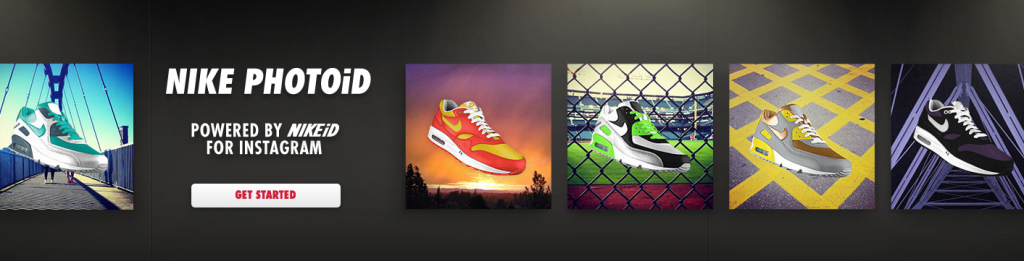
Nike has long been a customization leader with its line of totally customizable sneakers, dubbed NikeiD. Now, the company has partnered with photo-sharing service Instagram to allow users to create their own sneakers with an even more unique element of customization. Through the new service, Nike PHOTOiD, users can customize Air Max sneakers with the color palettes from their most cherished Instagram photo moments. Forget wearing your heart on your sleeve. Now, it’s all about wearing your favorite moments on your feet.